The recycled plastics market is growing fast. Valued at over $70 billion in 2025 and projected to reach more than $100 billion by 2033, the sector is being driven by binding recycled-content regulations in the EU and US, rising demand for food-grade rPET, and corporate sustainability commitments from major brand owners. EU producers alone will need to source an estimated 5.4 million tonnes of rPE, rPP, and rPET annually by 2030 under the Packaging and Packaging Waste Regulation.
The challenge is that scaling recycling output is not just a logistics problem. It is fundamentally a filtration problem.
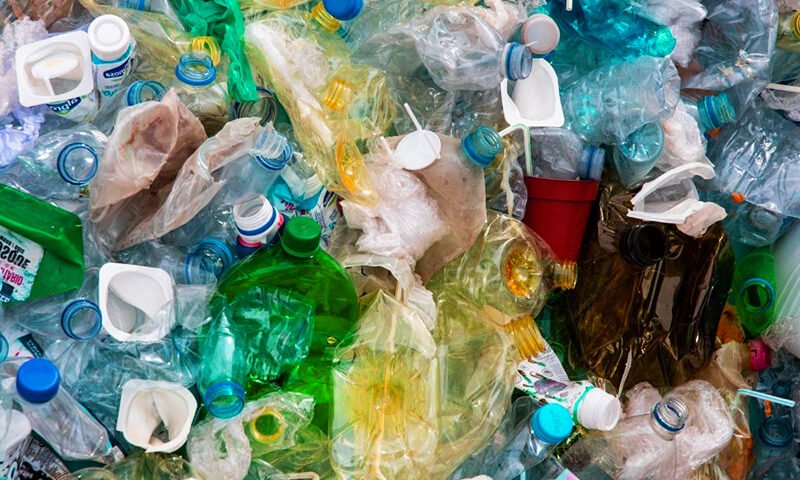
Post-consumer plastic waste is heavily contaminated — with paper fibres, adhesive residues, pigments, degraded polymer, moisture, and foreign particulate matter. Processing this feedstock through an extrusion line puts enormous pressure on the melt filtration system. Lines that rely on traditional screen packs — manually replaced flat filters — struggle to maintain throughput when contamination levels are high. The result is frequent stops, labour-intensive changeovers, pressure instability, and inconsistent output quality.
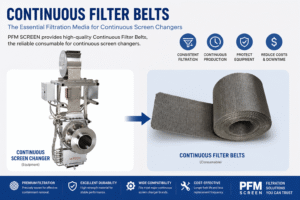
Continuous filter belts, used in automatic screen changers, are the solution most high-throughput recycling operations turn to. This article explains why melt filtration is so critical in recycling lines, what makes continuous belts effective, and how to specify the right belt for your material stream.
Why Melt Filtration Is Non-Negotiable in Plastic Recycling
In virgin polymer extrusion, melt filtration is relatively straightforward. The feedstock is consistent, contamination levels are low, and screen packs can run for extended periods before requiring replacement.
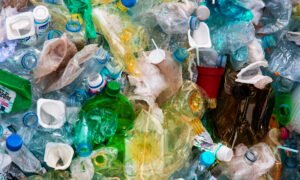
Recycled plastic is fundamentally different. Post-consumer streams — PE film, PET bottles, PP packaging, mixed rigid containers — carry contaminants that cannot be removed by washing alone. Adhesive residues from labels, degraded polymer fragments, rubber particles, paper fibres, aluminium foil shreds, and unmelted agglomerates all enter the melt stream and must be captured before the melt reaches the die.
The consequences of inadequate filtration are direct and measurable:
- Gel defects and black specks in film and sheet products, rendering them unsuitable for packaging applications
- Spinnerette blockage in fibre and nonwoven lines, causing line stoppages and equipment damage
- Pressure spikes downstream of a clogged screen, stressing the screw, barrel, and die
- Degraded melt homogeneity, producing output with inconsistent mechanical properties
- Loss of food-grade certification eligibility, eliminating the highest-value market for recycled resin
Filtration quality is also increasingly a commercial requirement, not just a process parameter. Buyers of rPET, rPP, and rHDPE are tightening specifications. Food-contact applications require demonstrable purity. Brand owners purchasing recycled pellets for packaging demand consistency across batches. Recyclers who cannot deliver this face downward price pressure or loss of contracts entirely.
The Downtime Problem: Why Screen Packs Fail on Recycling Lines
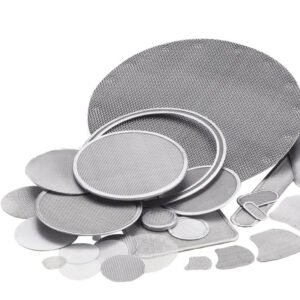
Traditional flat screen packs — woven wire mesh discs or rectangular filters held in a slide-plate or bolt-type screen changer — work well on virgin material. On heavily contaminated recycled feedstock, they fail for one fundamental reason: they load up too quickly.
On a post-consumer PE or rPET line, a screen pack may need to be changed every 30 minutes to 2 hours depending on contamination level. Each change requires the operator to stop the extruder, cool the die, remove the contaminated screen, insert a fresh one, purge the system, and restart. In a 24/7 operation, this cycle adds up to several hours of production loss per shift, significant labour cost, and substantial material waste in purge.
The economics are straightforward. A recycling line running at 500 kg/h that experiences two 30-minute stops per shift loses 500 kg of output every day. At a pellet value of $0.80–$1.20/kg for rPP or rPE, that is $400–$600 of lost production daily, before accounting for energy, labour, and purge material.
Continuous screen changers with belt-type filters solve this problem at its root. The belt advances automatically — triggered by a pressure differential sensor — so fresh filtration media is always in contact with the melt. Operators load a new roll when the current one is exhausted, typically a task that takes under five minutes and does not require stopping the line.
How Continuous Filter Belts Work
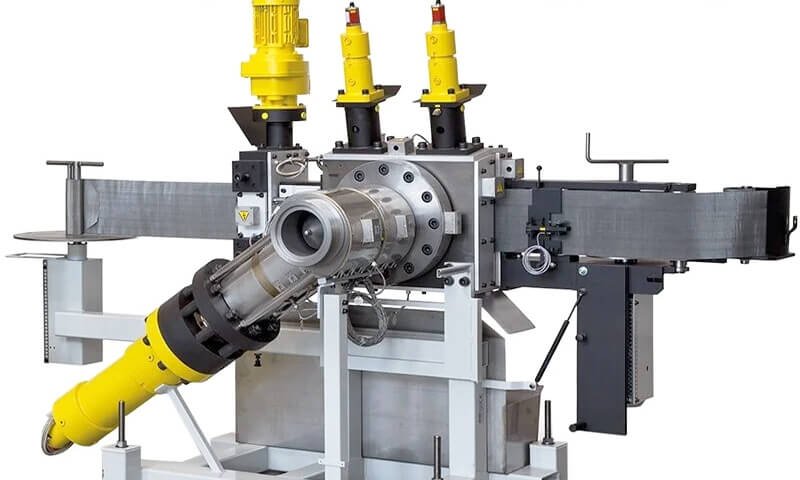
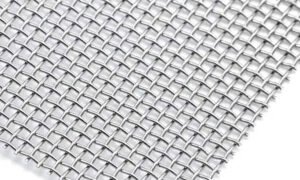
A continuous filter belt is a woven wire mesh roll — typically constructed in a Reverse Dutch Weave (RDW) pattern from stainless steel wire — that feeds through a continuous screen changer. As the belt passes through the filtration zone, it intercepts contaminants from the melt stream. When pressure across the belt rises beyond a set threshold, the changer automatically indexes the belt forward, moving contaminated mesh out of the filtration zone and presenting clean mesh to the melt.
The key design elements that make this work reliably are:
- Reverse Dutch Weave structure: The RDW pattern — with closely packed weft wires locked beneath the warp — provides high tensile strength in the machine direction, precise and stable filtration openings, and resistance to mesh distortion under cyclic pressure loading. These properties are essential for a belt running continuously under tension through a screen changer mechanism.
- Precision-slit edges: The belt must be cut to exact width for the screen changer channel. Even a 1–2 mm deviation causes melt bypass at the belt edges, contaminating the filtered melt and accelerating belt wear.
- Roll form supply: Belts are supplied on rolls of up to 100 metres. Longer rolls mean fewer changeovers and more uninterrupted runtime.
- Material grade matched to polymer: Standard 304 stainless steel is suitable for most PE, PP, and PET recycling. 316L is specified for PVC recycling lines or any application involving chlorine-bearing additives or high-temperature cleaning agents.
Recommended Micron Ratings for Common Recycled Polymer Streams
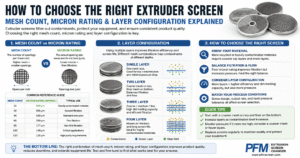
Selecting the correct micron rating is the most critical specification decision for a recycling line. Too fine, and the belt clogs rapidly, consuming roll length quickly and raising operating cost. Too coarse, and contaminants pass through, degrading output quality.
The right starting point depends on the polymer type, the contamination level of the feedstock, and the quality specification of the end product.
| Material Stream | Contamination Level | Recommended Micron Range | Notes |
|---|---|---|---|
| Post-consumer rPE (film, bags) | High | 200–400 µm | High dirt loading from mixed household waste; coarser rating extends belt life and reduces operating cost |
| Post-consumer rPP (rigid packaging) | Medium–high | 150–300 µm | Label adhesive and pigment residues are common; 200 µm is a practical starting point |
| rPET (clear bottle flake) | Medium | 100–200 µm | Requires finer filtration to meet food-grade and fibre-grade quality standards; 150 µm is typical |
| rPET (mixed or coloured) | Medium–high | 150–250 µm | Higher contaminant load from coloured and opaque bottles; balance filtration fineness with belt consumption rate |
| Post-industrial PE/PP trim and rejects | Low | 80–150 µm | Clean, well-characterised feedstock; finer rating improves pellet quality for demanding applications |
| Mixed rigid plastics (HDPE, PP, ABS) | High | 250–400 µm | Highly variable contamination; coarser rating essential to prevent rapid belt loading |
| Rubber-containing streams | High | 200–400 µm | Rubber particles and cross-linked fragments require coarser filtration to prevent immediate blockage |
Practical guidance: If you are setting up a new line or switching feedstock, start with a coarser rating than you expect to need. Monitor pressure differential and belt consumption rate over the first production run. If melt quality meets specification and belt consumption is manageable, you can evaluate moving to a finer rating. Moving in the opposite direction — from too fine to coarser — always costs roll length and downtime.
Operating Cost Comparison: Continuous Belt vs. Screen Pack on a Recycling Line
The per-metre cost of a continuous filter belt is higher than the per-unit cost of a flat screen pack. This comparison is misleading, because it ignores the true drivers of operating cost on a contaminated recycling line.
Consider a typical post-consumer PE or rPP line running at 400–600 kg/h with moderate to high contamination:
| Cost Factor | Screen Pack System | Continuous Belt System |
|---|---|---|
| Screen changes per shift | 4–8 (every 1–2 hours) | 0–1 (belt roll change only) |
| Downtime per change | 20–40 minutes | Under 5 minutes (roll change) |
| Labour required | Dedicated operator per change | Minimal — belt advances automatically |
| Purge material loss per change | 5–20 kg | Near zero |
| Pressure consistency | Cyclic — peaks before each change | Stable — fresh media always in contact |
| Output quality consistency | Degrades toward end of each screen cycle | Consistent throughout production run |
The production time recovered by eliminating manual screen changes is typically the dominant cost factor. For high-output recycling operations running 16–24 hours per day, the payback on switching to a continuous screen changer system is often measured in months, not years.
Specifying the Right Belt Width
Belt width must match the filter channel width of the screen changer exactly. This is a machine-specific specification — not a choice. Common widths in recycling applications include 97 mm, 120 mm, 150 mm, and 200 mm, corresponding to the major continuous screen changer brands (Erema, Gneuss, Ettlinger, Nordson BKG, Kreyenborg).
If you are sourcing replacement belts for an existing machine, the correct width is specified in the screen changer manual. If you no longer have the manual, the width is usually stamped or labelled on the machine body near the filter inlet. Sending us the machine make and model number is also sufficient — we can confirm the correct width before you order.
For lines being designed or upgraded, a wider belt generally means a larger filtration area, lower pressure drop per unit area, and slower belt advancement rate — all of which reduce belt consumption and operating cost at high throughput.
Summary: Key Selection Criteria for Recycling Lines
Before specifying a continuous filter belt for a plastic recycling application, confirm the following:
- Belt width: Matches the screen changer channel width exactly (verify from machine manual or machine body stamp)
- Micron rating: Selected based on polymer type, feedstock contamination level, and output quality target — start coarser, refine based on operational data
- Weave type: Reverse Dutch Weave (RDW) for all continuous screen changer applications
- Material grade: 304 SS for standard PE, PP, PET recycling; 316L for PVC or lines using aggressive cleaning agents
- Roll length: Maximise roll length for your width — longer rolls mean fewer changeovers and more uninterrupted runtime
View our full continuous filter belt specification range, including widths from 50–300 mm and micron ratings from 35–400 µm. For recycling line applications with specific contamination challenges, contact us with your feedstock type, throughput, and current screen change frequency — we will recommend the most cost-effective specification for your line.