When sourcing extruder screen packs, one of the first decisions you’ll face is construction type: welded, framed, or pleated. Each design has distinct structural characteristics, filtration performance, and suitability for different extrusion conditions.
Choosing the wrong type leads to premature screen failure, increased pressure drop, more frequent changeovers, and ultimately higher operating costs. This guide gives you a clear, technical comparison so you can make the right call.
What Is an Extruder Screen Pack?
A screen pack sits in the die adapter or screen changer between the extruder screw and the die. Its job is to:
- Filter solid contaminants and gels from the polymer melt
- Build back-pressure to improve melt homogeneity
- Protect downstream tooling (dies, gear pumps, spinnerets)
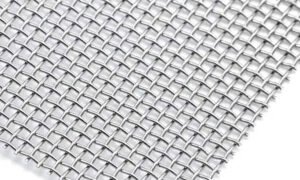
Most screen packs consist of one or more layers of woven wire mesh — but how those layers are held together defines the pack type.
Construction Type 1: Welded Screen Packs
How They’re Made
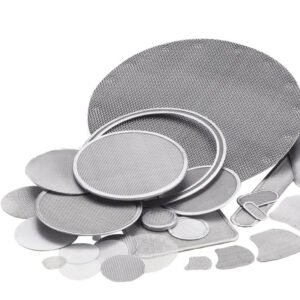
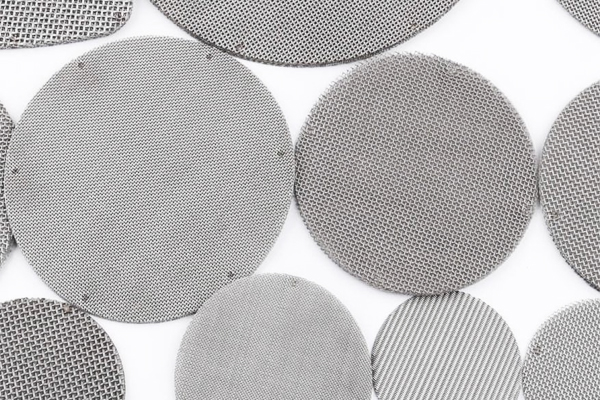
Welded screen packs are manufactured by resistance-welding the mesh layers together at the edges or at a grid of spot-weld points. No frame is used. The weld fuses the mesh wires directly.
Key Characteristics
| Property | Detail |
|---|---|
| Edge treatment | Welded perimeter (no frame) |
| Thickness | Thin — typically 1–4 mm total |
| Rigidity | Moderate — weld points prevent layer separation |
| Max operating pressure | Up to ~200–250 bar depending on mesh spec |
| Cleanability | Not typically cleaned; single-use |
| Common configurations | Square, circular, custom shapes |
When to Choose Welded
Welded packs work best in moderate-contamination, mid-viscosity extrusion processes where:
- The screen changer or breaker plate provides structural support
- You need a thin pack that fits shallow breaker plate recesses
- Layer integrity during installation is critical (layers won’t slide or shift)
- You’re running PE, PP, PS, or ABS at standard extrusion pressures
Typical applications: Blown film, pipe extrusion, sheet extrusion, profile extrusion
Limitations
- Weld points can create flow disruption near edges
- Not suitable for very high pressures without additional frame support
- Less surface area than pleated designs at equivalent footprint
Construction Type 2: Framed Screen Packs
How They’re Made
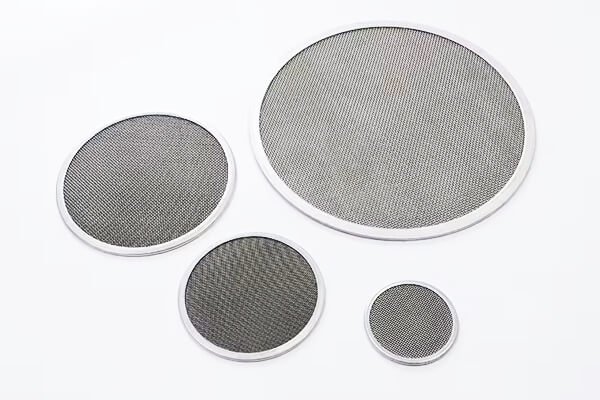
Framed screen packs encapsulate one or more mesh layers within a rigid metal ring or border frame — typically stainless steel or carbon steel. The frame is press-fitted or welded around the outer diameter or perimeter of the mesh assembly.
Key Characteristics
| Property | Detail |
|---|---|
| Edge treatment | Rigid metal frame (ring or square border) |
| Thickness | Medium — frame adds 2–5 mm to pack height |
| Rigidity | High — frame prevents deformation under pressure |
| Max operating pressure | 250–400+ bar |
| Sealing | Frame creates positive seal against breaker plate face |
| Common configurations | Circular with OD ring, square with full border |
When to Choose Framed
Framed packs are the preferred choice when:
- Operating pressures are high (above 200 bar consistently)
- The process involves high-viscosity polymers (PET, PA, engineering resins) that generate significant melt pressure
- You need a positive seal to prevent melt bypass around the screen edges
- The screen changer design has a deep recess or requires a self-locating screen pack
- You’re running screen changers without continuous support (e.g., slide plate or bolt-type screen changers)
Typical applications: PET fiber spinning, engineering resin compounding, heavy-wall pipe, masterbatch production
Limitations
- Heavier than welded packs — more material cost
- Frame reduces active filtration area slightly compared to full-face welded designs
- Higher per-unit cost, especially in exotic alloys
Construction Type 3: Pleated Screen Packs
How They’re Made
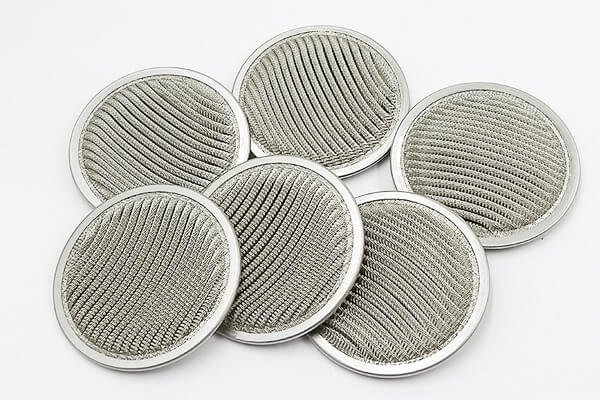
Pleated screen packs fold the filtration media — typically fine mesh or a composite multi-layer structure — into an accordion-style pleat pattern. The pleated element is then assembled into a support frame or housing. This is a fundamentally different approach compared to flat welded or framed packs.
Key Characteristics
| Property | Detail |
|---|---|
| Filtration area | 3–8× greater than equivalent flat pack |
| Operating pressure | Moderate — typically up to 150–200 bar |
| Service life | Significantly longer due to larger dirt-holding capacity |
| Pressure drop | Lower initial ΔP for equivalent micron rating |
| Form factor | Disc, cartridge, or custom pleated element |
When to Choose Pleated
Pleated packs offer a major advantage when:
- Contamination levels are high (recycled materials, regrind, post-consumer resin)
- You want to extend service intervals between screen changes to reduce downtime
- Your process is pressure-sensitive and you need to minimize pressure drop
- You’re running fine filtration (below 80 microns) and need more area to maintain throughput
- The screen changer is designed for pleated elements (some continuous belt or backflush systems)
Typical applications: Plastic recycling lines, post-consumer PET processing, high-contamination PP/HDPE, color concentrate production
Limitations
- Not compatible with all screen changer designs (requires specific housing geometry)
- Higher initial unit cost
- Pleated media can be more sensitive to flow surge and thermal shock
- Not suitable for very high pressures without reinforced support structure
Side-by-Side Comparison
| Parameter | Welded | Framed | Pleated |
|---|---|---|---|
| Filtration surface area | 1× (baseline) | ~0.9× (frame reduces area) | 3–8× |
| Max pressure tolerance | Medium (up to ~250 bar) | High (250–400+ bar) | Lower (up to ~200 bar) |
| Pressure drop (initial) | Medium | Medium | Low |
| Service life | Standard | Standard | Extended |
| Contamination handling | Moderate | Moderate | High |
| Compatibility | Most screen changers | Most screen changers | Selected screen changers |
| Cost per unit | Low–Medium | Medium–High | Medium–High |
| Installation | Easy | Easy–Medium | Requires correct housing |
| Best for | Standard extrusion | High-pressure, high-viscosity | Recycling, contaminated feeds |
How to Decide: A Process-Based Decision Framework
Use this framework to narrow your selection:
Step 1: Check your operating pressure
- Below 200 bar consistently → welded or pleated are both viable
- Above 200 bar regularly → framed pack is the safer choice
- Pressure spikes above 300 bar → framed with heavy-duty support mesh essential
Step 2: Assess your contamination load
- Clean virgin resin → welded pack is sufficient
- Mixed virgin + regrind → welded or framed depending on pressure
- High contamination / recycled content >30% → pleated for extended run life
Step 3: Evaluate your screen changer type
- Bolt-type or slide plate → welded or framed
- Continuous belt / backflush → consult manufacturer; pleated elements may be available
- Manual screen change → any type; framed helps with self-location
Step 4: Consider your filtration fineness target
- Above 150 microns → single-layer welded is often adequate
- 40–150 microns → multi-layer welded or framed (with support mesh)
- Below 40 microns → pleated for sustainable throughput; or framed with Dutch weave mesh
Step 5: Factor in changeover cost
- Frequent changes acceptable → welded is cost-effective
- Downtime is costly → pleated extends intervals; framed reduces leak risk during changes
Layer Configuration Within Each Type
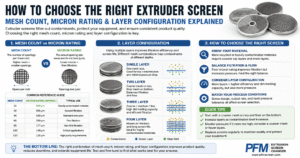
Regardless of construction type, most screen packs use a multi-layer structure:
| Layer | Mesh Count | Role |
|---|---|---|
| Coarse support (upstream) | 10–30 mesh | Structural support, pre-filter |
| Primary filtration | 60–325 mesh | Main contamination capture |
| Fine filtration (optional) | 200–500 mesh | Gel removal, fine particle capture |
| Downstream support | 10–20 mesh | Prevents media blowout |
For framed and welded types, typical 3-layer or 4-layer configurations are standard. Pleated elements often use a composite pre-laminated media in lieu of separate loose layers.
Material Considerations
All three types are available in:
- SS 304 — standard grades, most common
- SS 316L — chloride-containing or aggressive polymers
- SS 316Ti — elevated temperature stability
- Monel / Inconel — fluoropolymers (PVDF, PTFE), highly corrosive melts
- Phosphor bronze — PVC processing (resists chloride stress corrosion)
Match material to polymer chemistry — not just temperature. For guidance, see our upcoming article: SS304 vs. SS316L Extruder Screens: Which Stainless Steel Grade Should You Choose?
Summary
There is no universally “best” screen pack construction type. The right choice depends on your operating pressure, polymer type, contamination level, and screen changer design:
- Welded → reliable, cost-effective, broad compatibility
- Framed → high-pressure integrity, positive sealing, long-term durability
- Pleated → maximum filtration area, extended service life, ideal for recycled resins
When in doubt, describe your application to your screen pack supplier — pressure, throughput, polymer, and changeover frequency — and request a technical recommendation.
PFM SCREEN manufactures all three construction types in standard and custom configurations, with material options from SS304 to Inconel. Contact our technical team for application-specific recommendations.