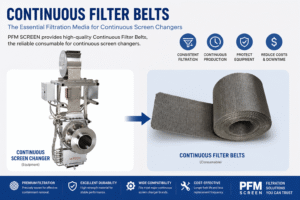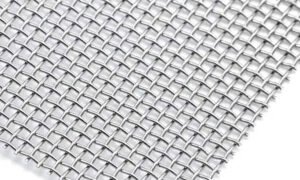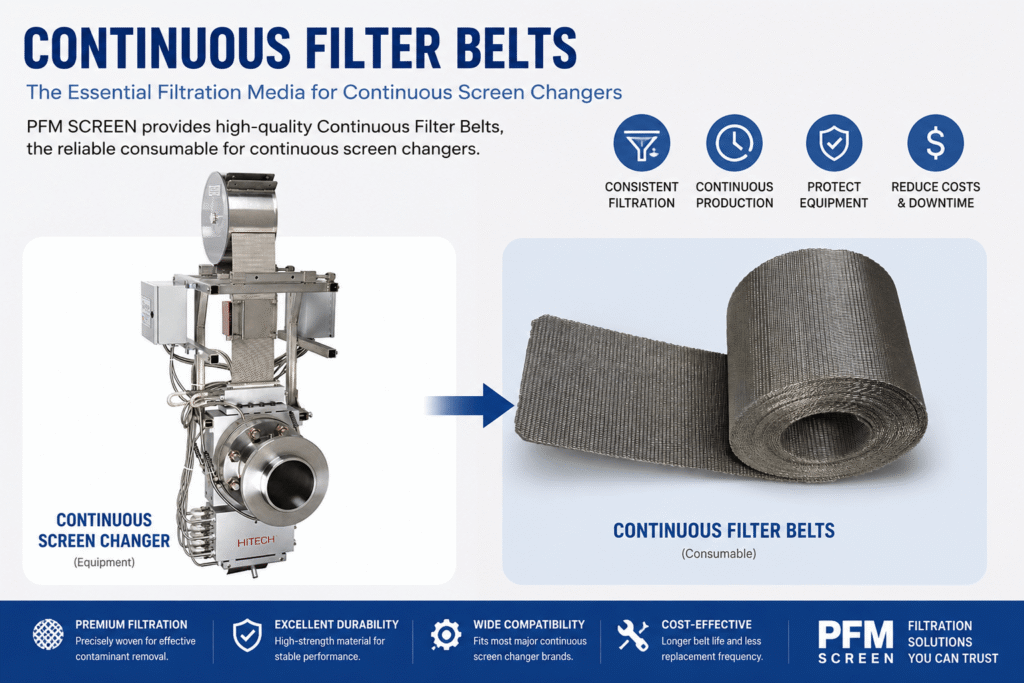
A continuous filter belt is a woven wire mesh roll — typically made from stainless steel in a Reverse Dutch Weave (RDW) pattern — used in automatic screen changers to provide uninterrupted melt filtration during plastic extrusion and recycling. Unlike traditional screen packs that require line stoppages to replace, a continuous filter belt advances automatically, keeping fresh filtration media in contact with the melt at all times.
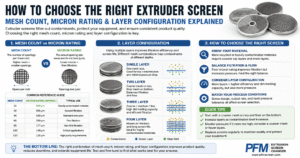
Choosing the wrong belt — wrong width, wrong micron rating, wrong material grade — leads to pressure instability, premature belt failure, or poor melt quality. This guide walks you through the four key selection steps.
Step 1: Match the Belt Width to Your Screen Changer
Belt width must match your screen changer’s filter channel width exactly. Even a 1–2 mm mismatch can cause melt bypass or mechanical damage to the belt edge.
Check your screen changer’s manual for the specified belt width. If you no longer have the manual, the width is usually stamped on the machine body near the filter inlet.
Common belt widths by brand:
| Screen Changer Brand | Model Examples | Common Belt Widths |
|---|---|---|
| Erema | RSFgenius, Intarema | 97 mm, 120 mm, 150 mm |
| Gneuss | MRS, MRF series | 120 mm, 150 mm, 200 mm |
| Ettlinger | ERF series | 150 mm, 200 mm |
| Nordson BKG | Continuous belt models | 120 mm, 150 mm, 200 mm |
| Kreyenborg | Belt-type models | 97 mm, 150 mm |
If your brand or model is not listed, send us your machine model number and we will confirm the correct width before you order.
Step 2: Choose the Right Micron Rating for Your Material
The micron rating determines what particle size the belt will capture. Finer ratings (lower micron number) remove smaller contaminants but increase pressure drop and require more frequent belt advancement.
Recommended micron ratings by material:
| Material | Recommended Micron Range | Notes |
|---|---|---|
| Recycled PE / PP (post-consumer) | 200–400 µm | High contaminant load; coarser rating reduces belt consumption |
| Recycled PET (rPET) | 100–200 µm | Moderate contamination; balance between quality and throughput |
| Virgin PE / PP film extrusion | 80–150 µm | Low contamination; finer rating improves surface quality |
| Fiber / nonwoven (melt-blown, spunbond) | 35–80 µm | Requires fine filtration to prevent spinnerette blockage |
| Rubber extrusion | 200–400 µm | High viscosity material; coarser rating prevents pressure spikes |
| PVC profiles / compounds | 150–250 µm | Check thermal stability requirements — prefer 316L grade |
General rule: Start with a coarser rating than you think you need. You can always move finer once you have baseline pressure data. Going too fine on a contaminated feed causes rapid belt consumption and high operating cost.
Step 3: Select the Correct Weave Type
Most continuous screen changers require Reverse Dutch Weave (RDW), and for good reason — it offers the best combination of tensile strength and filtration accuracy for belt applications.
| Weave Type | Tensile Strength | Filtration Precision | Typical Use |
|---|---|---|---|
| Reverse Dutch Weave (RDW) | ⭐⭐⭐⭐⭐ | ⭐⭐⭐⭐⭐ | Standard for all continuous screen changers |
| Plain Dutch Weave (PDW) | ⭐⭐⭐ | ⭐⭐⭐⭐ | Lower pressure applications |
| Twill Dutch Weave | ⭐⭐⭐⭐ | ⭐⭐⭐⭐ | Where higher dirt-holding capacity is needed |
Unless your screen changer manufacturer specifies otherwise, always specify RDW. Its tight weft wire packing gives it the mechanical strength to withstand the tension and pressure cycles of a continuous changer without distorting the mesh openings over time.
Step 4: Choose the Right Material Grade
For most applications, 304 stainless steel is sufficient. Upgrade to 316 or 316L when processing materials that contain chlorides, halogens, or corrosive additives.
| Grade | When to Use |
|---|---|
| SS 304 | Standard PE, PP, PET, ABS — virgin or recycled |
| SS 316 / 316L | PVC, flame-retardant compounds, materials with chlorine or halogen additives |
| Nickel alloy | Highly corrosive specialty polymers, fluoropolymers |
Note: 316L (low carbon) is preferred over standard 316 when the belt will be exposed to repeated high-temperature cleaning cycles, as it offers better resistance to sensitization.
Common Mistakes to Avoid
Using the wrong width. Even a small mismatch causes melt leakage around the belt edge, which contaminates the filtered melt and shortens belt life. Always measure or verify before ordering.
Going too fine too quickly. A 50 µm belt on a heavily contaminated recycling feed will clog within minutes, driving up belt consumption and cost. Match the micron rating to your actual contamination level.
Ordering standard grade for PVC lines. PVC degrades to release hydrochloric acid at processing temperatures. Using 304 grade on a PVC line leads to corrosion and premature belt failure. Always specify 316L for PVC.
Ignoring roll length. Longer rolls mean fewer changeovers and less production interruption. For high-speed or 24/7 lines, order the maximum roll length available for your width.
Summary: Quick Selection Checklist
Before placing an order, confirm the following:
- ✅ Belt width matches screen changer channel width exactly
- ✅ Micron rating selected based on material type and quality target
- ✅ Weave type specified as RDW (unless otherwise required)
- ✅ Material grade matched to polymer chemistry (304 for standard, 316L for PVC/corrosive)
- ✅ Roll length maximized for your production schedule
View our full continuous filter belt specification range including widths from 50–300 mm and micron ratings from 35–400 µm. Not sure which spec fits your machine? Contact us with your screen changer model and we will confirm compatibility before you order.