The global wedge wire screen market is valued at approximately $822 million in 2026 and is projected to reach $1.15 billion by 2035 (CAGR 3.8–4.2%). Behind this steady growth curve is a structural shift in the industries that depend on wedge wire screens most heavily: water and wastewater treatment is undergoing its largest infrastructure investment cycle in a generation, driven by urbanization, aging municipal systems in developed economies, and water scarcity accelerating desalination and water reuse projects worldwide.
For procurement engineers, plant designers, and filtration equipment manufacturers, understanding where wedge wire screen technology is heading — and why — is essential for specifying the right product for the next decade of operations.
What Makes Wedge Wire Screens Distinct
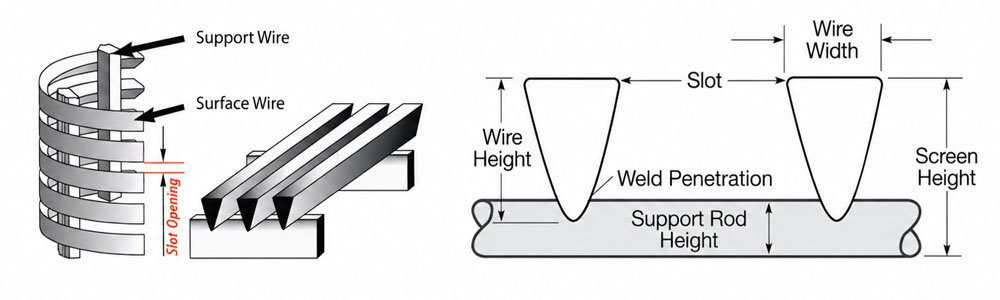
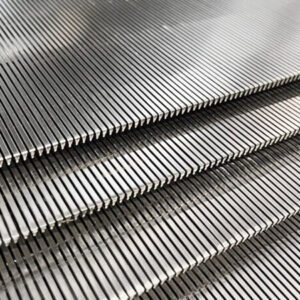
A wedge wire screen (also known as a profile wire screen or V-wire screen) is a precision-welded filtration element constructed from two structural components: surface profile wires and support rods. The profile wires — typically triangular (V-shaped) in cross-section — are welded onto the support rods at each intersection using resistance welding, creating a rigid lattice with a continuous slot opening running parallel to the profile wire axis.
The geometry of the V-profile wire is what gives wedge wire screens their defining technical characteristics. The slot opening is narrowest at the surface and widens progressively inward — a diverging aperture that provides three critical performance advantages over conventional woven wire mesh or perforated plate:
Anti-blinding geometry: Particles that partially enter the slot are not trapped at the surface. The diverging taper means that any particle small enough to enter the slot can pass through completely, preventing the progressive blinding that plagues screens with parallel-sided apertures or convergent profiles.
High open area: Despite their structural rigidity, wedge wire screens achieve open area percentages of 15–50% depending on slot size and wire pitch — comparable to or exceeding woven mesh in equivalent particle retention ratings.
Structural integrity under pressure: The resistance-welded construction distributes mechanical loads across the entire lattice. Wedge wire panels routinely operate under differential pressures exceeding 10 bar and flow velocities incompatible with fragile woven mesh constructions.
These properties make wedge wire screens the preferred screening medium for applications where continuous operation, minimal maintenance intervals, and long asset life are primary requirements — exactly the profile demanded by water treatment infrastructure.
The Water Treatment Infrastructure Driver
Municipal Water Supply and Wastewater Treatment
The United Nations estimates that global water demand will exceed supply by 40% by 2030 without significant infrastructure investment. In response, public utility capital expenditure on water and wastewater infrastructure has accelerated sharply across all major economic regions:
- Europe: The EU Water Framework Directive and the revised Urban Wastewater Treatment Directive (UWWTD, 2022) require member states to eliminate nutrient pollution and achieve tertiary treatment at more sewage treatment works by 2035. This mandates significant retrofitting of existing plants, including upgraded intake and preliminary screening stages where wedge wire screens are the standard technology.
- United States: The Bipartisan Infrastructure Law (2021) allocated $55 billion to water infrastructure over five years. Municipal utilities are deploying this capital on intake screen replacement, fine screening upgrades, and new capacity — all heavy wedge wire screen consumers.
- Middle East and North Africa: Desalination plant capacity additions are accelerating, particularly in Saudi Arabia, UAE, and Kuwait. Wedge wire intake screens on seawater desalination plants handle the first stage of solids removal before membrane systems, representing a high-value, application-critical segment.
- Asia-Pacific: China, India, and Southeast Asia are constructing new wastewater treatment plants at a pace driven by urbanization rates of 1–2% per year. The Asia-Pacific wedge wire screen segment is projected to expand at 4.5% CAGR through 2035, the highest of any region.
Desalination Intake Screens
Seawater reverse osmosis (SWRO) desalination plants require particularly demanding intake screening. The wedge wire intake screen must exclude marine organisms and debris while handling tidal fluctuation in flow velocity and seasonal variation in suspended solids loading — all without biological fouling accumulating to the point of pressure drop. The design response has been traveling band screens and drum screens built with wedge wire panels, typically with slot openings of 1–6 mm and cathodic protection systems in seawater environments.
Globally, desalination capacity is projected to grow from approximately 100 million m³/day in 2025 to over 160 million m³/day by 2035. Each large-scale SWRO plant (50,000–500,000 m³/day capacity) requires multiple traveling band screen units with wedge wire panels totaling hundreds of square meters of screen area — and these panels require scheduled replacement at intervals of 5–10 years depending on operating conditions.
Industrial Wastewater: Zero Liquid Discharge and Water Reuse
Beyond municipal water systems, industrial wastewater regulations are tightening in all major economies. The European Union’s Industrial Emissions Directive, China’s “Beautiful China” environmental standards, and US EPA effluent limitation guidelines are pushing industrial facilities toward closed-loop water systems and zero liquid discharge (ZLD) — where all process water is recovered and reused, generating only a solid waste stream.
ZLD systems require multiple stages of solid-liquid separation at high suspended solids concentrations. Wedge wire sieve bend screens (curved DSM screens) operating at 45–90° arc angles are essential in the preliminary dewatering stages that reduce solids loading before centrifuges, filter presses, or evaporators. Their ability to handle high-viscosity, high-solids slurries without blinding makes them a preferred technology in this application.
Wedge Wire Screen Geometry and Engineering Fundamentals
Profile Wire and Support Rod Geometry
The wedge wire screen’s performance is determined by the selection of profile wire and support rod dimensions in combination with the slot width and pitch (center-to-center spacing between profile wires).
| Parameter | Typical Range | Effect on Performance |
|---|---|---|
| Slot width | 0.02 mm – 10 mm | Particle retention rating; narrower slots = finer filtration |
| Profile wire height | 1.5 mm – 6 mm | Open area and flow capacity |
| Profile wire width (base) | 2 mm – 8 mm | Structural strength, determines solid fraction |
| Pitch (wire spacing) | 2 mm – 25 mm | Open area percentage |
| Support rod pitch | 10 mm – 300 mm | Panel stiffness and pressure resistance |
For water treatment applications, slot widths of 0.5–3 mm are most common in intake screening, sieve bend dewatering, and secondary screening stages. Fine-slot configurations down to 0.1–0.2 mm are used in tertiary polishing screens for reuse water applications.
Material Selection for Water Treatment Environments
Water treatment environments expose wedge wire screens to conditions that demand careful material specification. Chloride stress corrosion cracking, microbiologically influenced corrosion (MIC), and erosion from abrasive suspended solids are the primary degradation mechanisms.
AISI 304 (1.4301): The entry-level specification for fresh water applications with low chloride content. Suitable for clean surface water intake screens and groundwater systems. Not recommended for brackish or saline environments.
AISI 316L (1.4404): The standard specification for most water treatment applications. The 2–3% molybdenum content provides significantly improved resistance to chloride pitting compared to 304. Appropriate for municipal wastewater, brackish water intake, and industrial process water with moderate chloride levels (less than 500 mg/L Cl⁻).
Duplex Stainless Steel 2205 (1.4462): The premium specification for challenging water environments — seawater intake screens, high-chloride industrial effluent, and MIC-prone applications. Duplex grades offer approximately twice the yield strength of 316L, allowing lighter-section construction at equivalent structural performance, and superior stress corrosion cracking resistance.
Super Duplex 2507 (1.4410): Specified for the most aggressive environments — direct seawater immersion, hypersaline brine streams in desalination concentrate discharge, and chemical process streams with high halide content. The very high PRE (Pitting Resistance Equivalent) of greater than 40 makes it the choice for long-life critical applications where screen replacement would require plant shutdown.
Titanium Grade 2 / Grade 5: The highest corrosion resistance, specified for seawater screens where even super duplex would face pitting risks, or for chemical process streams where stainless steel is categorically excluded. Cost is 3–5× that of duplex grades but justified by asset life of 15–25 years.
Flow Direction and Construction Type
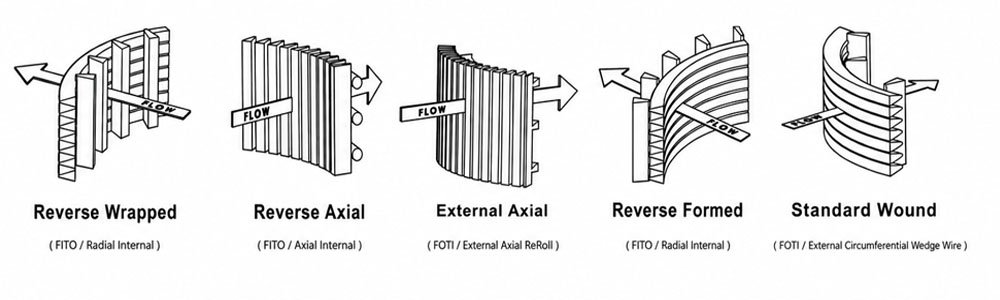
Wedge wire screens for water treatment are manufactured in four principal construction configurations, each suited to different hydraulic and solids loading conditions:
Flat panels (FOTI — flow outside to inside): The most common form for traveling band screens, rotary drum screens, and flat static panels. Profile wires run in the plane of the screen; flow passes from the external face through the slot into a void behind the panel.
Curved panels (sieve bend / DSM screens): Flat panels formed into an arc (typically 45°, 60°, or 90°). Used in gravity dewatering applications where the slurry flows across the curved screen face under gravity. Slot widths of 0.25–2 mm are standard in pulp and paper, food processing, and wastewater dewatering applications.
Cylinders (FOTI): Profile wires wound helically around axial support rods, creating a screen cylinder. Used as well screens, in-line strainers, intake screens in pipeline configurations, and rotary drum filter media. The helical wound construction produces a screen with no welded seam joints and highly consistent slot dimensions.
Cylinders (FITO — flow inside to outside): Support rods wound helically on the outside of axial profile wire elements. Used in screen laterals, header-lateral distribution systems in water treatment filters, and resin retention screens in ion exchange units.
Applications in Water Treatment: A Stage-by-Stage Analysis
Stage 1: Coarse Intake Screening
At surface water intakes (rivers, reservoirs, coastal seawater), traveling band screens or drum screens with wedge wire panels handle the first removal of debris — fish, leaves, plastics, and suspended solids larger than 1–6 mm. The trend toward finer intake screening (slot widths of 1–2 mm vs. the legacy 3–6 mm standard) is driven by downstream membrane protection requirements. Ultrafiltration and nanofiltration pretreatment systems that feed SWRO desalination are sensitive to microscopic debris at concentrations that a 6 mm screen ignores but a 1 mm screen captures.
Stage 2: Fine Screening and Primary Solids Removal
Rotary drum screens and static sieve bend panels handle the next solids reduction stage. In municipal wastewater treatment, rotary drum fine screens with 0.2–1 mm slot wedge wire panels replace or supplement traditional bar screens to capture smaller organic solids before primary sedimentation. Approach velocity at the screen face must remain below approximately 0.15 m/s for fine screening applications to avoid forcing particles through the slot.
Stage 3: Sludge Dewatering and Thickening
Sieve bend screens play a critical role in sludge handling within water treatment plants. Primary and secondary sludge (typically 0.5–3% total solids) is applied to curved wedge wire panels for gravity dewatering to 5–8% total solids before further processing by centrifuges or belt filter presses. The cross-flow screening mechanism exploits the turbulence at the sieve bend face to maintain continuous self-cleaning. For municipal wastewater applications, stainless steel 316L sieve bend panels with 0.5 mm slots are the standard specification.
Stage 4: Filtration and Tertiary Treatment
In tertiary water reuse applications, wedge wire cylinders serve as resin traps and underdrain laterals in granular media filters. Slot width selection for underdrain laterals must satisfy a dual constraint: narrow enough to retain the finest media particle (typically 0.25–0.35 mm slot for fine sand media), yet wide enough to avoid excessive fouling by fines mobilized during backwash. Installed in cylinders of 50–150 mm diameter.
Mining: The Other Major Growth Driver
Water treatment is the largest application segment for wedge wire screens, representing approximately 44% of the global market. Mining — the second-largest segment — is growing at a comparable rate.
Mining operations use wedge wire screens across multiple process stages:
Mineral classification: Vibrating flat wedge wire panels classify crushed ore by particle size. The continuous slot geometry handles the abrasive, high-density slurries (specific gravity 1.5–2.5) that destroy woven wire mesh within days. Wear-resistant alloy upgrades extend screen life in high-abrasion applications.
Dewatering: Sieve bend panels and static fine screens dewater mineral concentrates before filtration or drying. In coal washing, wedge wire sieve bends handle coal slurry at 100–500 m³/h throughput rates, recovering fine coal particles from the process water before the water is recycled to the washing circuit.
Sand and aggregate washing: Flat wedge wire panels in inclined screen configurations process sand and gravel, combining size classification and dewatering in a single pass. Slot widths of 0.5–2 mm handle fine aggregate classification down to 0.5 mm particle size.
Tailings management: Tightening environmental regulations on tailings storage facilities are increasing the demand for more efficient initial dewatering — reducing the volume and increasing the solids content of tailings before impoundment.
Food Processing: Precision and Sanitary Design
Food and beverage processing represents approximately 20% of the wedge wire screen market by value. The critical requirements include slot width tolerance of ±0.05 mm, hygienic construction with surface finish Ra ≤ 0.8 µm, and full CIP compatibility with hot caustic (NaOH, 1–2%) and acid (phosphoric or nitric acid, 0.5–1%) cleaning cycles at 80–90°C.
In fruit juice extraction (apple, citrus, tomato), rotating drum screens with wedge wire panels (0.2–0.5 mm slot) are the primary separation technology. The continuous slot allows pulp particles above the slot width to be conveyed across the drum face and discharged, while clarified juice passes through — a gentle separation that preserves product quality better than high-shear centrifugal alternatives.
Emerging Application: Microplastic and Micropollutant Screening
EU regulations on microplastic discharge — expected to establish mandatory removal thresholds at wastewater treatment plants by 2028–2030 — are driving early-mover investment in fine screening technologies. Wedge wire screens with slot widths of 50–200 µm are being evaluated for microplastic removal in dynamic drum screen configurations. At these very fine slot sizes, the anti-blinding geometry of the V-profile wire becomes even more critical — without the diverging taper, screens of this fineness would require impractically frequent cleaning cycles.
PFM SCREEN’s Wedge Wire Screen Capabilities
PFM SCREEN manufactures a comprehensive range of wedge wire screen products for water treatment, mining, food processing, and industrial filtration applications:
Flat Wedge Wire Panels — Rectangular panels for traveling band screens, static fine screens, vibrating screens, and support grids. Manufactured in widths up to 3,000 mm and lengths up to 4,000 mm. Slot widths from 0.1 mm to 10 mm. Standard material AISI 316L; Duplex 2205/2507, Super Duplex, Titanium, and Hastelloy available on request.
Curved Sieve Bend Panels (DSM Screens) — Arc-formed panels in 45°, 60°, and 90° configurations for gravity dewatering applications. Custom arc radii from 300 mm to 2,000 mm. Available in fixed-installation and cartridge formats for standard DSM screen frames.
Wedge Wire Cylinders and Tubes — Spiral-wound and roll-formed cylinders for water well screens, underdrain laterals, resin retention screens, and in-line strainers. Diameters from 25 mm to 900 mm. Both FOTI and FITO flow configurations.
Well Screens — Continuous slot water well screens for groundwater extraction, dewatering wells, and environmental monitoring wells. Manufactured to API and ISO standards. Screen lengths up to 6 meters per section.
Wedge Wire Baskets and Cone Screens — Custom-formed basket and conical screen elements for centrifuges, pressure strainers, and specialty process equipment. All geometries available from engineering drawings or reverse-engineered from sample parts.
All wedge wire products are manufactured using resistance welding equipment with real-time weld current monitoring, ensuring consistent joint quality across high-volume production runs. Dimensional inspection and slot width verification are performed on all production batches.
Market Outlook: Key Themes for 2026–2035
Finer slot specifications: The general trend across all end markets is toward finer screening — driven by tighter downstream process requirements and stricter environmental standards. Producing consistent 0.1–0.5 mm slots at commercial volumes requires precision wire drawing, consistent wire geometry, and accurate CNC-controlled welding fixtures.
Corrosion-resistant alloys: As seawater desalination capacity expands and industrial wastewater regulations tighten, demand for Duplex, Super Duplex, and titanium wedge wire is growing faster than the market as a whole.
Asia-Pacific growth leadership: The fastest absolute volume growth in wedge wire screens through 2035 will occur in Asia-Pacific, particularly China, India, Vietnam, and Indonesia — all undergoing major water infrastructure investment cycles.
Smart screening systems: IoT-enabled wedge wire screens with embedded pressure differential sensors and automated cleaning control systems are moving from pilot installations to commercial deployment, reducing spray wash water consumption by 20–40% and extending screen and cleaning nozzle service life.
The wedge wire screen market’s growth over the next decade will be fundamentally tied to two macro trends: the global resolution of water scarcity through infrastructure investment, and the tightening of industrial and municipal environmental standards that demand finer, more reliable solid-liquid separation. Both trends are structural and multi-decade in nature — providing a durable demand foundation for technically capable wedge wire screen manufacturers.
PFM SCREEN supplies wedge wire screen panels, sieve bend screens, cylinders, and well screens for water treatment, mining, food processing, and industrial applications worldwide. Contact our engineering team for specifications, material selection guidance, and custom quotation.