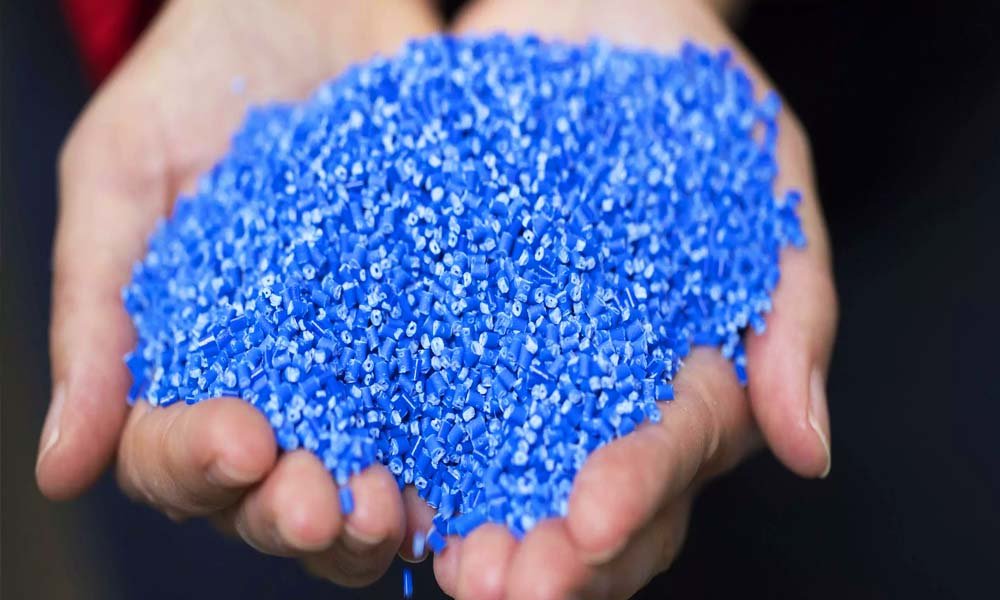
The global plastic recycling industry is undergoing a structural transformation. Regulatory mandates in the European Union, the United States, and across Asia-Pacific are compelling brand owners, resin producers, and recycling operators to dramatically scale up post-consumer and post-industrial plastic reprocessing. In 2026, this shift is placing unprecedented technical demands on one of the most critical — and often overlooked — components in any plastic extrusion line: the melt filtration screen.
The Regulatory Landscape Driving Demand
Two legislative frameworks are reshaping the economics of plastic recycling at a global scale.
In the European Union, the Packaging and Packaging Waste Regulation (PPWR) establishes mandatory minimum recycled content thresholds in plastic packaging — 30% for PET bottles by 2030, with interim procurement decisions already affecting resin buyers in 2026. Simultaneously, the EU’s plastic packaging tax of €0.80/kg on non-recycled packaging waste is pushing brand owners to actively seek high-quality recycled resin, regardless of cost premium. The EU’s Carbon Border Adjustment Mechanism (CBAM), fully implemented in 2026, adds further pressure by penalizing high-carbon production chains.
In the United States, Extended Producer Responsibility (EPR) legislation has expanded to 12 states as of 2026, with California’s SB 54 mandating a 65% reduction in single-use plastic waste by 2032. These policies are creating a sustained capital investment cycle in mechanical recycling infrastructure.
The recycled plastics industry is expected to expand from its current value of approximately $40–50 billion to $76.2 billion by 2030, achieving a CAGR of 5.2%. As the market grows, companies are increasingly prioritizing investments in high-capacity extrusion lines capable of producing 1,500–3,500 kg/h during 2025–2026.
The Contamination Problem in Post-Consumer Recyclate
Recycled feedstock presents filtration challenges that virgin polymer processing never encounters. Post-consumer recyclate (PCR) — whether HDPE bottles, LDPE agricultural film, PET packaging, or mixed polyolefins — enters the extruder carrying a complex burden of contaminants:
- Hard particulates: Mineral fillers, glass fibers, calcium carbonate, metal fragments from shredding, and silica from soil contact
- Soft gel particles: Cross-linked polymer gels, degraded polymer chains, and incompatible polymer blends that form discrete inclusions in the melt
- Volatile organics: Residual solvents, inks, adhesives, and decomposition products from thermal degradation
- Biological contaminants: Organic residues, paper fiber, and biological matter from food-contact packaging
Each contaminant class requires a different filtration strategy. Screen packs capture hard particulates at the screen face through surface filtration, while multi-layer screen constructions remove gel particles and soft inclusions through depth filtration. Upstream degassing systems control volatiles, and fine-mesh screens capture the condensed residues that remain in the melt.
The critical parameter is melt cleanliness: for food-grade rPET applications commanding $800–1,200/tonne in 2026, gel-free, contamination-free melt is not merely desirable — it is a prerequisite for market access.
Filtration Mechanisms in Polymer Melt Processing
Polymer melt filtration operates under conditions that have no parallel in liquid filtration. The medium being filtered is a non-Newtonian viscoelastic fluid with:
- Melt temperatures of 180–300°C depending on polymer type (PE at 180–220°C, PP at 200–240°C, PET at 270–300°C)
- Melt pressures of 50–350 bar at the filter face, with pressure drops of 20–150 bar across the screen pack under normal operating conditions
- Shear-thinning viscosity that decreases dramatically under the high shear rates generated through screen apertures
- Viscoelastic memory effects that cause the melt to partially recover its original conformation after passing through a restriction
Under these conditions, three competing factors determine filtration efficiency: aperture size controls the effectiveness of surface filtration, bed depth and tortuosity influence the performance of depth filtration, and differential pressure across the screen pack governs both throughput and the screen pack’s structural integrity.
Screen Aperture and Filtration Fineness
For post-consumer PE and PP recyclate, screen packs with filtration ratings of 80–150 µm (equivalent to approximately 100–200 mesh in square weave) are standard for pelletizing applications where downstream product quality tolerates some residual gel. For demanding applications — food-contact rPET, fiber-grade PP, or optical-quality film — filtration fineness of 20–40 µm is required, necessitating fine Dutch weave or multi-layer sintered mesh configurations.
The weave geometry governs the relationship between mesh count, wire diameter, and aperture size. In a plain square weave:
Aperture (µm) = (25,400 / Mesh Count) − Wire Diameter (µm)
A 200-mesh screen with a 40 µm wire diameter yields an aperture of approximately 87 µm. To achieve 20 µm filtration in a square weave, wire diameters below 20 µm are required — at the technical limit of conventional weaving. This is why reverse Dutch weave (also called Dutch twill weave) is the preferred construction for fine filtration: the asymmetric interlacing creates a triangular pore geometry that permits very fine filtration ratings (down to 5–10 µm) while using heavier wire gauges that provide structural robustness.
Multi-Layer Screen Pack Construction
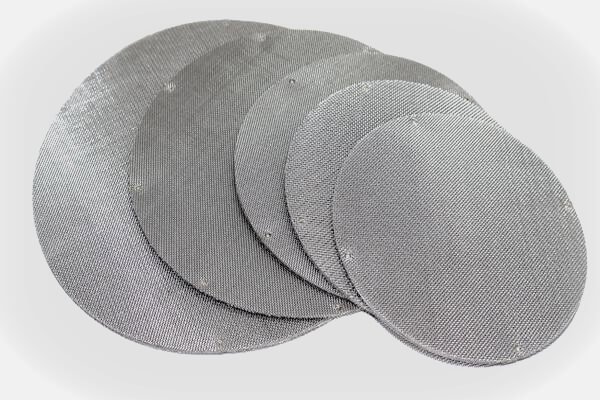
Recycling processors rarely use single-layer screens. Instead, they assemble multi-layer screen packs in a defined sequence to distribute mechanical loads and achieve graded filtration. A typical four-layer pack for PCR polyolefin processing may consist of:
| Layer | Mesh Count | Function |
|---|---|---|
| Upstream support | 20–40 mesh | Coarse pre-filtration, structural support |
| Intermediate coarse | 60–80 mesh | Secondary particle capture |
| Fine filter layer | 120–200 mesh | Primary filtration, gel capture |
| Downstream support | 20–40 mesh | Distributes backpressure, prevents screen extrusion |
The fine filter layer carries the bulk of the filtration work. The coarse support layers serve a structural function: at 100–300 bar of melt pressure, a fine mesh screen without backing will deform into the breaker plate holes and eventually rupture, destroying the integrity of the filtration stage and contaminating the product melt with metal fragments — a catastrophic outcome in food-contact applications.
For highly contaminated streams, welded or sintered multi-layer packs replace loose-assembled screens. In these constructions, individual mesh layers are permanently bonded by spot welding at the periphery or by diffusion bonding across the full face area (sintered mesh). Sintered packs offer superior dimensional stability and eliminate layer migration under cyclic pressure variations — a failure mode common in recycling lines where feedstock contamination levels fluctuate significantly between batches.
Continuous Filter Belts for High-Volume Recycling Lines
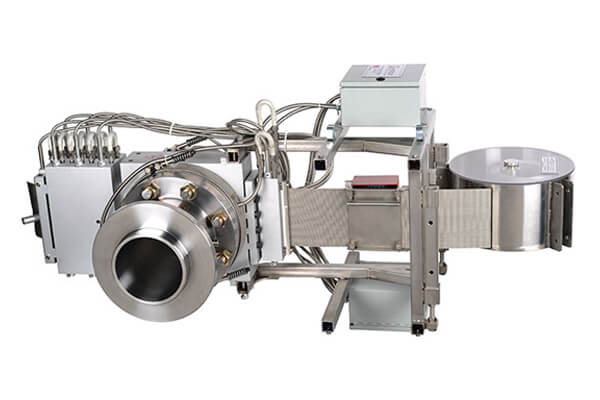
Conventional screen changers require operators to briefly stop the extruder or interrupt melt flow to replace clogged screen packs, making them incompatible with the 24/7 production demands of high-capacity recycling lines. In response, recycling processors have widely adopted continuous belt screen changers (also called automatic screen changers), which advance a continuous roll of wire mesh through the melt channel at a controlled rate.
The belt is advanced automatically as the differential pressure across the screen climbs toward a preset threshold, continuously presenting fresh filter area to the melt stream without stopping production. Key technical requirements for continuous filter belts in recycling service include:
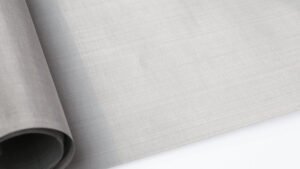
- Weave type: Reverse Dutch weave (twill Dutch weave) with high tensile strength in the machine direction to withstand belt tension under melt pressure
- Wire material: AISI 316L stainless steel for standard polymer streams; higher-alloy grades (310S, Inconel) for high-temperature engineering polymers
- Width tolerance: ±0.2 mm across the belt width to ensure uniform sealing in the screen changer housing
- Joint design: Seamless or precision-joined belts to eliminate particle bypass at splice points, which would create unfiltered melt pathways
Continuous filter belts enable recycling operators to achieve 99.9% uptime on pelletizing lines — a commercially critical parameter when processing $1,000+/tonne food-grade rPET that cannot tolerate production interruptions.
Pleated Extruder Screens: Increasing Filter Area Without Increasing Machine Size
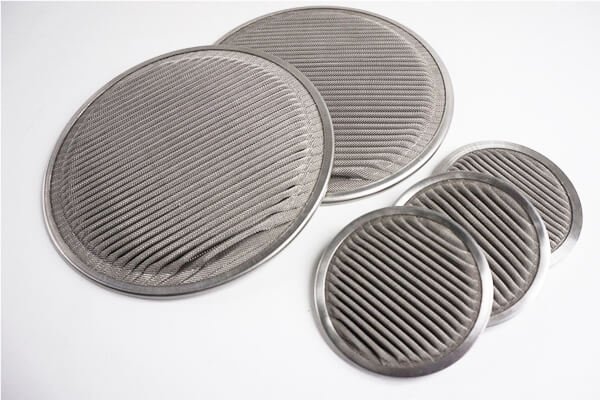
A pleated extruder screen is a wire mesh screen formed into a corrugated geometry before insertion into the breaker plate. The corrugation dramatically increases the effective filter area relative to the breaker plate bore diameter — a 100 mm diameter pleated screen can provide 3–5× the filter area of a flat screen of the same bore.
This increased area has two direct operational benefits. First, the lower face velocity (melt flow per unit area) reduces the rate of surface fouling and extends screen service life proportionally. Second, the lower pressure drop across a larger, partially loaded screen reduces shear stress on the polymer melt — a critical consideration for shear-sensitive polymers like PET, where excessive shear accelerates viscosity degradation through chain scission.
Pleated screens are particularly valuable in recycling applications where contaminant loading is high and unpredictable. By extending screen life, they reduce the frequency of screen changes — each of which typically results in 2–5 minutes of production downtime in manual screen changers and generates waste material that must be reprocessed.
Material Selection for Recycling Service
The corrosive environment within a polymer melt extrusion system is severe. Thermal degradation of PVC, PVDC, and halogenated flame retardants in mixed plastic waste streams generates hydrochloric acid (HCl) at parts-per-million concentrations — sufficient to cause stress corrosion cracking in standard 304 stainless steel screens within weeks of service.
Material selection guidelines for recycling screen packs:
- AISI 316 / 316L: Standard choice for polyolefin (PE, PP) and PET streams. Mo content (2–3%) provides adequate resistance to mild chloride exposure.
- AISI 310S: Recommended for high-temperature streams above 280°C, such as engineering polymers (PA, PBT, POM) and high-temperature recycled PET.
- Duplex stainless steel (2205, 2507): Superior resistance to stress corrosion cracking in chloride-containing streams. Preferred for mixed plastic waste with unknown flame retardant content.
- Inconel 625 / 601: Specified for streams containing significant PVC content, where HCl generation is substantial. The high Ni-Cr-Mo composition provides exceptional resistance to halide corrosion.
In sintered multi-layer packs, material selection applies to all layers, as the diffusion bonding process during sintering creates a continuous metallurgical structure — there is no weak-link interface between dissimilar metals as there would be in mechanically assembled packs.
The Quality Imperative: Melt Index Consistency and Gel Count
The commercial value of recycled resin in 2026 is directly correlated with two measurable quality parameters: melt flow index (MFI) consistency and gel count per unit area (typically measured on cast film by optical transmission).
Inconsistent MFI — caused by inadequate homogenization or variable contamination levels — makes the recycled resin unsuitable for compounding or film production, where narrow MFI tolerance windows (±0.5–1.0 g/10 min) are standard specifications. Excessive gel count — typically defined as fewer than 50 gels per 100 cm² for packaging-grade material — disqualifies the resin from food-contact and optical applications.
Fine-mesh extruder screens are the last line of defense for both parameters. By capturing gel-forming contaminants before they reach the die, a properly specified screen pack directly determines whether a batch of post-consumer material meets the quality threshold for premium applications — or is downgraded to lower-value uses.
Advanced recycling lines in 2025–2026 integrate real-time pressure differential monitoring across the screen pack as a process control input. Rising differential pressure indicates increasing contaminant loading, triggering either automatic belt advancement (in continuous systems) or a planned screen change (in manual systems) before screen failure or product contamination occurs. Some operators correlate differential pressure data with MFI measurements to build predictive models of screen service life as a function of feedstock quality.
PFM SCREEN’s Extruder Screen Product Range
PFM SCREEN manufactures a comprehensive range of extruder filtration products engineered for both virgin polymer processing and the demanding conditions of plastic recycling service:
Welded Extruder Screen Packs — Multi-layer screen packs with peripheral spot welding for dimensional stability. Available in standard circular diameters from 25 mm to 600 mm, and custom square or rectangular formats. Mesh configurations from 20 to 500 mesh; standard material AISI 304/316L with higher-alloy grades on request.
Continuous Filter Belts — Reverse Dutch weave belts for automatic and continuous screen changers. Custom widths from 30 mm to 300 mm, with any length. AISI 316L standard; 310S and Inconel available for high-temperature and corrosive service.
Frame Extruder Screen Packs — Screen packs with machined metal frames for direct insertion into hydraulic or manual screen changers. The frame eliminates sealing concerns and ensures precise alignment in the screen changer housing.
Pleated Extruder Screen Packs — Corrugated mesh screens providing 3–5× filter area increase within the existing breaker plate bore. Particularly suitable for recycling lines with high contamination variability.
Cylindrical Extruder Screens — Tubular mesh filter elements for rotary or cylindrical screen changer systems, including back-flush capable designs.
Special Shape Extruder Screens — Custom-formed screens for non-standard screen changer geometries, including oval, rectangular, and multi-bore configurations.
All products are manufactured under ISO quality management protocols, with dimensional inspection and documentation traceable to each production batch.
Outlook: Filtration as a Competitive Differentiator in Recycling
As the plastic recycling industry matures from a niche activity into a large-scale industrial sector, the technical performance of melt filtration is becoming a key competitive variable. Operators who invest in precision filtration — appropriate screen pack construction, correct material selection, and modern continuous belt technology — are able to produce higher-grade recycled resin that commands premium pricing and broader market acceptance.
The pressure to upgrade filtration systems will intensify as regulatory quality thresholds for recycled content rise. The EU PPWR’s minimum recycled content mandates are triggers not just for volume — they are increasingly specifying quality floors that only well-filtered, consistently processed rPET, rHDPE, and rPP can meet.
In this environment, the extruder screen is no longer a commodity consumable. It is a precision process component whose specification directly determines the value of the recycled resin stream.
PFM SCREEN supplies extruder screen packs, continuous filter belts, and custom filtration solutions for plastic extrusion and recycling applications worldwide. Contact our technical team for application-specific consultation and quotation.