

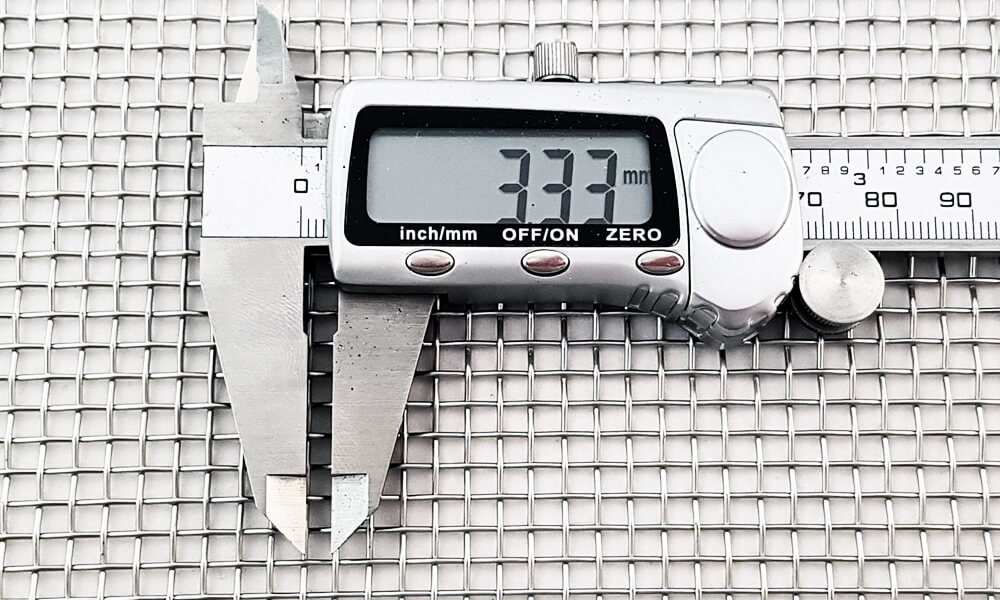
Entering the world of industrial wire mesh can feel a bit like learning a new language. You’ll hear terms like “mesh count,” “opening size,” and “microns” tossed around, often interchangeably, which can lead to costly ordering mistakes.
Whether you are using mesh for architectural accents, high-precision chemical filtration, or simple sifting, understanding how these specifications interact is critical. This guide breaks down the technical DNA of woven wire mesh.

1. Mesh Count: The Foundation
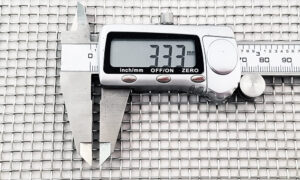
Mesh count is the most common way to identify wire mesh. It refers to the number of openings per linear inch (25.4 mm), measured from the center of one wire to the center of the next wire exactly one inch away.
- Low Mesh Count: (e.g., 2 to 10 mesh) Features large openings and thick wires. Think of a heavy-duty security screen.
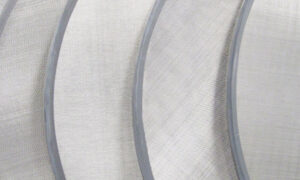
- High Mesh Count: (e.g., 200 to 635 mesh) Features tiny openings and hair-thin wires. These look and feel more like silk fabric than metal.
Pro Tip: When counting mesh, always start from the center of a wire to ensure accuracy. If you count from the edge of the opening, your math might be slightly off.
2. Wire Diameter: Strength and Stability
The wire diameter is the thickness of the wire before it is woven. This is a crucial spec because it directly affects the mesh’s durability and the size of the resulting hole.
- Standard Diameters: Manufacturers usually have a “standard” wire diameter for every mesh count to balance strength and flow.
- Custom Diameters: You can often request “heavy” wire for extra durability or “light” wire to increase the open area, though this may require a custom production run.
3. Aperture (Opening Size) and Microns
While mesh count tells you how many holes there are, the Aperture tells you the size of the hole itself. This is the “clear” distance between two adjacent wires.
In fine filtration, we often use Microns (μm) to describe this opening.
- 1 Micron = 1/1000 of a millimeter.
- For perspective, a human hair is roughly 50 to 70 microns thick.
Why this matters
If you are filtering a liquid to remove particles larger than 100 microns, you need a mesh with an aperture slightly smaller than 100 microns. The mesh count alone won’t tell you this, as different wire diameters will result in different apertures for the same mesh count.
5. The Math: How They Connect
The relationship between mesh count, wire diameter, and aperture is purely mathematical. If you know two of these values, you can calculate the third using the following formula:
Where:
- A = Aperture (Opening) in mm
- N = Mesh Count (per inch)
- d = Wire Diameter in mm
Percentage of Open Area
Engineers also look at the Percentage of Open Area, which determines the flow rate (how much air or liquid can pass through).
A higher open area means better flow but a more fragile mesh.
5. Common Weave Types
The way the wires are interlaced also changes the specification’s performance.
| Weave Type | Characteristics | Best Use |
| Plain Weave | Simple “over-one, under-one” pattern. | Most common; standard filtration/screening. |
| Twilled Weave | Each wire passes over and under two wires. | Allows for heavier wires in fine mesh counts. |
| Dutch Weave | Uses different diameters for warp and weft wires. | High-pressure filtration; very small micron ratings. |
Summary Checklist for Newcomers
When requesting a quote or designing a part, ensure you have these four details ready:
- Material: (e.g., Stainless Steel 304, 316, or Brass)
- Mesh Count: (e.g., 40 x 40 mesh)
- Wire Diameter: (e.g., 0.25 mm)
- Dimensions: (Roll width and length, or cut-to-size pieces)
Understanding these specs ensures you don’t end up with a mesh that is either too restrictive for your flow or too weak for your pressure.