

Selecting the right stainless steel wire mesh is a critical decision for industrial processes. The right mesh ensures optimal filtration, mechanical strength, durability, and process efficiency, while the wrong choice can lead to premature wear, clogging, or reduced output.
This guide provides a step-by-step framework to help engineers, procurement managers, and industrial buyers choose the correct stainless steel wire mesh for their applications.
1. Understand Your Application Requirements
Before evaluating materials and specifications, clearly define your operational needs. Key questions include:
- Purpose: Are you using the mesh for filtration, screening, particle separation, reinforcement, or safety protection?
- Medium: Will it handle liquids, gases, slurries, or solid particles?
- Process Conditions: What are the temperature, pressure, and chemical conditions in the application?
Example Scenarios:
- Polymer melt filtration: Requires fine micron retention and high-temperature resistance.
- Mining screens: Prioritize mechanical strength and abrasion resistance.
- Food processing: Must comply with hygiene standards, resist corrosion, and be easy to clean.
Understanding your application first ensures the right mesh type, material, and weave are selected for optimal performance.
2. Select the Appropriate Stainless Steel Grade
Different stainless steel grades provide varying corrosion resistance, strength, and temperature tolerance. Common industrial grades include:
| Grade | Key Properties | Typical Applications |
|---|---|---|
| 304 | General corrosion resistance, economical | Food, beverage, general filtration |
| 316 | Excellent resistance to chlorides and acids | Marine, chemical, pharmaceutical |
| 316L | Low carbon, ideal for welding and high-temperature use | High-pressure filtration, chemical processing |
| Duplex / Super Duplex | High strength, superior corrosion resistance | Oil & gas, seawater filtration |
| Monel / Inconel | Exceptional corrosion and heat resistance | Petrochemical, chemical, high-temperature industrial processes |
Tip: For European industrial standards, 316L and Duplex grades are widely accepted and preferred for chemical, marine, and high-pressure applications.
3. Choose the Right Weave Type
The weave type determines mechanical strength, flow characteristics, and filtration precision. Common options:
3.1 Plain Weave
- Structure: Each warp wire passes over and under each weft wire alternately.
- Characteristics: Simple, square openings, high open area.
- Pros: Easy to clean, cost-effective, suitable for general screening.
- Cons: Lower strength for fine mesh; limited filtration precision.
3.2 Twill Weave
- Structure: Warp wire passes over two and under two weft wires.
- Characteristics: Diagonal pattern, allows finer mesh, improved flexibility.
- Pros: Higher tensile strength; better resistance to deformation.
- Cons: Slightly lower open area than plain weave.
3.3 Dutch Weave
- Structure: Warp and weft wires differ in diameter; used for precision filtration.
- Variants: Plain Dutch, Twill Dutch, Reversed Dutch.
- Pros: High pressure tolerance, ultra-fine filtration (1–400 microns).
- Applications: Polymer melt filters, fuel filtration, chemical processing.
3.4 5-Heddle Weave
- Structure: Complex multi-frame weave providing maximum structural integrity.
- Pros: Extremely strong, durable under heavy-duty conditions.
- Applications: Mining, pulp & paper, vibrating screens, high-load industrial filtration.
Tip: Reversed Dutch weaves optimize flow and pressure distribution for extrusion and chemical filtration.
4. Determine Mesh Size and Wire Diameter
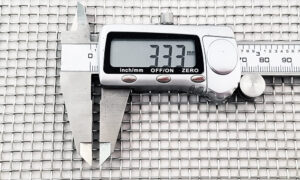
- Mesh Size (Openings per Inch/CM): Higher mesh numbers filter finer particles.
- Wire Diameter: Thicker wires → greater mechanical strength; thinner wires → finer filtration.
Balance is critical:
- Ultra-fine mesh with thin wires can clog easily under heavy loads.
- Thick wires reduce filtration precision but improve durability and longevity.
Example: A 400-mesh screen with 0.03 mm wire may achieve sub-50 micron filtration, but may not be suitable for abrasive slurry without damage.
5. Consider Open Area and Flow Rate
The open area (%) affects process efficiency:
- High open area → faster flow, lower pressure drop.
- Low open area → finer particle retention, slower flow rate.
Industrial Insight:
- Water treatment and chemical filtration often prioritize high open area for throughput.
- Precision polymer filtration prioritizes low open area to retain ultra-fine particles.
6. Evaluate Mechanical and Environmental Requirements
Assess the mesh’s ability to withstand operational stress:
- Tensile Strength: Ensures the mesh can handle tension, vibration, and mechanical load.
- Abrasion Resistance: Important for mining, slurry, and heavy solids filtration.
- Temperature and Pressure: Mesh grade and weave must tolerate maximum operating conditions.
- Chemical Resistance: 316, 316L, or specialty alloys are recommended for corrosive environments.
Tip: Consider service life in extreme conditions—over-engineering slightly often reduces downtime and maintenance.
7. Verify Compliance and Standards
High-quality stainless steel wire mesh should comply with industrial standards:
- DIN Standards (Germany): Mesh size, weave, and material quality.
- ISO Standards: Corrosion resistance, traceability, and dimensional accuracy.
- ASTM Standards (USA): Wire diameter, tensile strength, and mesh accuracy.
Advice: European industrial clients often require ISO/DIN certification—choose suppliers capable of providing certificates and test reports.
8. Decide Between Woven vs Welded Wire Mesh
| Type | Advantages | Limitations | Ideal Use |
|---|---|---|---|
| Woven | Precise filtration, flexible, high mesh counts possible | Less rigid | Screen packs, pleated filters, liquid filtration |
| Welded | Strong, rigid, durable | Limited fine mesh | Heavy-duty screens, partitions, protective guards |
9. Evaluate Supplier Capabilities
When sourcing stainless steel wire mesh:
- Confirm availability of custom weaving and sizes
- Check mesh count and weave accuracy
- Verify quality control processes and certifications
- Ensure after-sales support (cutting, framing, polishing, custom fabrication)
Tip: For exporting to Europe, suppliers experienced with DIN, ISO, and CE compliance can reduce technical barriers and inspection issues.
10. Key Takeaways
Choosing the right stainless steel wire mesh requires balancing filtration precision, mechanical strength, chemical resistance, and flow rate. Follow these steps:
- Understand your application and operational requirements
- Choose the appropriate stainless steel grade (304, 316, 316L, Duplex, Inconel)
- Select the correct weave type (Plain, Twill, Dutch, 5-Heddle)
- Determine mesh size and wire diameter based on particle size and flow requirements
- Balance open area with desired filtration precision
- Verify mechanical and environmental suitability
- Ensure compliance with DIN, ISO, or ASTM standards
- Decide between woven or welded mesh
- Evaluate supplier capability, certifications, and custom options
By carefully assessing these factors, you ensure maximum operational efficiency, extended service life, and reliable industrial performance.